
wtf is a thought daughter

If you want to be super smart and super hot this summer just like me, you need to read this long list of books. And if you haven’t read this long list of books, alongside watching this long list of YouTube videos and consuming seventeen podcasts hosted by women with slick buns and vocal fry, then unfortunately you are a stupid piece of shit.
In fact, not only are you stupid, you are morally failing.
Because in 2026, intelligence is no longer something you develop slowly over time through curiosity, lived experience or genuine engagement with the world. It is an aesthetic.
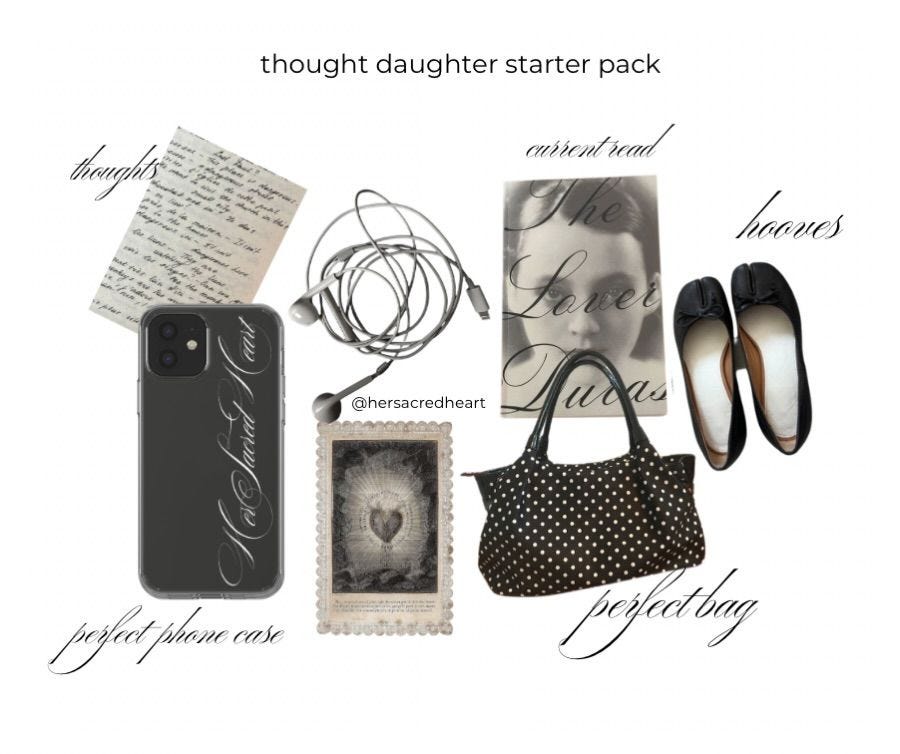
To be educated now is to endlessly consume. You must know everything about anything at all times. You must have read the right feminist texts, interpreted the right films correctly, listened to the right podcasts, held the right opinions with the correct amount of nuance and posted at least three Instagram stories proving you understood them.
Welcome to the age of the thought daughter.
So what the fuck is a thought daughter?
Good question. From my extensive academic research (scrolling TikTok at 1am and reading Urban Dictionary entries) the “thought daughter” is defined as a girl who thinks deeply. She enjoys spending time in nature, reading, learning, analysing the world around her and having existential crises in independent coffee shops either alone or alongside other equally philosophical women wearing long trench coats.
The term itself comes from the misogynistic and damaging internet question: “Would you rather have a gay son or a thot daughter?”
A question designed to reduce women to sexual shame and queer identity to parental disappointment. Peak internet culture.
Except somewhere along the way, people either intentionally or accidentally began reading “thot” as “thought” and thus, the thought daughter was born.

Arguably, the “thought daughter” sounds pretty fucking cool.
A woman who thinks deeply, analyses everything and wants to learn and understand the world around her? In many ways, that is the exact opposite of what women have historically been encouraged to become.
In a world that still benefits from women remaining quiet, agreeable and non-threatening, there is something undeniably powerful about women wanting to educate themselves. About women becoming politically informed, questioning social structures, discussing feminism, analysing culture and refusing to simply accept the world as it has been handed to them.
The thought daughter, at her best, is curious. She wants to know more, she wants to understand herself, she wants to understand other people.
For many women, especially those who have experienced trauma, alienation or the experience of existing online and in society as a woman, analysis becomes a way of making sense of the world. Reading theory, consuming psychology content, learning about feminism and identity and systems and power structures is not always performative. Sometimes it is an attempt to finally understand why everything has felt so difficult for so long.
The issue is not women thinking too much. The issue is that eventually, under capitalism and internet culture, even thinking itself becomes commodified. Now it’s is no longer: “oh, that sounds interesting, let me learn more.”
It becomes: “If you have not consumed this exact list of books, podcasts, theories, political opinions and niche video essays, then you are ignorant, problematic and fundamentally less intelligent than me.” Learning is no longer framed as something expansive, joyful or human, but as an endless competition. A race to know the most, articulate things the best and prove your intellectual worth at all times.
And because internet culture rewards capitalism, consumption and hyper-articulation, eventually an entire market begins forming around becoming the “thought daughter.”
Soon there is a starter pack: a specific tote bag, a specific coffee order, a list of books you must display on your bedside table whether you actually enjoyed reading them or not, three-hour video essays, a specific lip balm, the list goes on. Even intelligence itself becomes something to buy.
The thought daughter stops simply engaging with ideas and instead begins consuming an identity and with anything a woman does, it must be pretty.
Elisa, in her blog “You Are Not a Thought Daughter: On Intellectualism, Consumerism, and the Flattening of Identity,” perfectly captures this shift. The “thought daughter” is no longer simply a woman engaging critically with the world around her, but an increasingly flattened internet archetype built through consumption, aesthetics and performance.
I believe genuine intellectualism is messy. It is confusing. It is uncomfortable. Real learning often involves sitting with uncertainty, changing your mind, being wrong, reading things you do not fully understand and forming opinions slowly over time. It is most definitely not something you just buy or become.
In my blog, ‘What my insecurity taught me about intelligence’ I go into further detail around how most of my life, I have been told I am stupid because I did not exude what we culturally recognise as stereotypical intelligence. I was not effortlessly academic, I did not receive exceptional grades, I have not read every philosophical text known to mankind and I cannot name every artist, every movement, every piece of classic literature on command.
And for a long time, I internalised that as proof that I was intellectually lacking and I think the internet, and particularly “thought daughter” culture, reinforces an incredibly narrow and performative version of intelligence. One that is deeply tied to aesthetics, consumption and visibility.
Intelligence online is often treated as something you can visibly “look” like. It is the right vocabulary, the right references, the right bookshelf, the ability to immediately cite theory, politics, philosophy and culture in ways that sound impressive to other people online.
But some of the most intelligent people I know do not present like that at all. Some people think through feeling, through creativity, observation, emotional intelligence, lived experience and asking questions rather than immediately having answers.
And yet internet culture often flattens intelligence into one singular aesthetic performance: the hyper-articulated, hyper-informed, perfectly curated intellectual woman.
The “thought daughter.”
Which ironically leaves many genuinely curious, thoughtful and intelligent women feeling as though they are still somehow failing intellectually because they do not perform intelligence correctly. A lot of women end up feeling as though they do not deserve to take up space within these curated, so-called “intellectual” spaces. Sitting silently on the sidelines in fear that they might say the wrong thing, misunderstand a theory or fail to use the right academic language. I, being one of them.
For women especially, this pressure becomes intensified because women are already socialised to second-guess themselves constantly. So many women are not unintelligent, they are just terrified of being publicly perceived as unintelligent.
Ironically, some of the loudest “thought daughter” spaces online can end up reproducing the exact same exclusionary dynamics they claim to critique. Intellectualism becomes gatekept through aesthetics, language, references and performance rather than genuine openness, discussion or curiosity.
The result is not more women feeling empowered to think. It is more women feeling as though they must earn the right to speak first.
Maybe the problem is that women have been taught that in order for our thoughts to matter, they must first be perfectly articulated, aesthetically pleasing, academically approved and publicly validated. That we cannot simply be curious, we must be impressive.
Beneath all of that, I think there is still something deeply human sitting underneath the trend: women trying to understand themselves and the world around them in a society that has historically discouraged them from doing both.
Maybe intelligence does not need to look beautiful to be real.
loved this piece! i am as well frustrated with the internet placing intelligence in a specific box and the need to aesthetic-fy everything. and if you don’t know everything then as you rightfully said, your intelligence is casted away.
This piece made me feel heard. Often times when I am in a discussion/debate with others, specifically with men, I feel like I need to have prepared arguments, research, facts, numbers, statistics, all in excruciating detail, in order to feel like I *deserve* to be heard. I put research-paper effort into discussing my rights with men who don't even wash their ass!!! Let alone know what they're talking about!!
I love how this piece touched upon the commodification of intelligence. This 'thought daughter' archetype has moved on to Substack, which is maybe even more annoying than Tiktok and Instagram thought daughters. I think these identities serve no one and nothing except capitalism.