

on de-centering men without shaming women
the difference between liberation and emotional avoidance

Before diving in, I want to be clear: my goal is to offer a balanced exploration of the topic of de-centering men. As a feminist who runs a relatively popular page known for its feminine rage, I’m often seen as someone who advocates for de-centering men and, to some extent, that’s true. I believe deeply in women cultivating their own interests, reclaiming their power, and living lives that aren’t defined by men.
But what does “de-centering men” really mean? For me, it’s about seeing myself as a whole person, independent of male validation. It’s a practice rooted in unlearning the societal conditioning that tells women their worth is tied to attracting and keeping a man. The point isn’t to dismiss the value of romantic relationships, but rather to challenge the idea that they should come before our own ambitions or sense of self. This distinction is critical, and it’s where much of the nuance gets lost in online conversations.
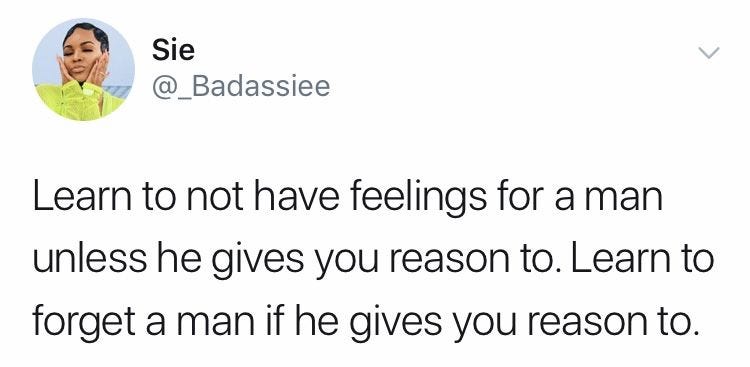
A quick scroll through social media will turn up countless posts with quotes like, “You don’t need a boyfriend, you need a hobby,” or “Don’t catch feelings for a man unless he gives you a reason.” These messages can oversimplify a complex reality.
After all, we’re not robots. We can’t shut off our feelings at will. Human connection is a basic need.
My concern with the de-centering movement (though arguably you could suggest this is the complete opposite) is the shame brought upon women who undoubtedly still want a relationship with a man, who plan their future to involve a man. I think it’s important to acknowledge that desiring romantic connection with men is not something to be ashamed of. Wanting a relationship or imagining your future alongside a man doesn’t make you any less independent, ambitious, or feminist. The goal should never be to shame women for their desires, but to encourage them to see themselves as whole, valuable, and powerful regardless of their relationship status.
At the same time, I think there’s a conversation to be had about how women sometimes prioritise men over other important connections, like female friendships. It’s possible to value romantic relationships while also recognising the importance of maintaining and nurturing our other bonds. The point is not to pit these choices against each other, but to reflect honestly on the balance we strike in our lives.
When we shame women for wanting to date men or for including romantic connection as part of their life goals, we end up missing the entire point of de-centering men. The focus shifts away from women and their own values, needs, and ambitions, and once again becomes about men—just in a different way. Instead of liberating women from the pressure to prioritise men, this kind of shaming still centres men in the conversation, simply from a different angle. True de-centring is about allowing women to define themselves and their priorities on their own terms.
I find it helpful to look at this topic from two lens: socialisation and psychology. What we do know is that women are socialised from an incredibly young age to see romantic desirability as part of their value. Girls absorb the message early that being chosen, wanted, beautiful, lovable, or partnered carries social currency. We see it everywhere: in films, family expectations, advertising, celebrity culture, and even in the way women are often spoken to compared to men. A woman without romantic success is still frequently framed as lacking something, while men are more easily allowed identities built around work, hobbies, status, humour, intellect, or independence.
So when women struggle to “de-center men,” I don’t think the answer is to mock them for it. Much of this behaviour is deeply conditioned. Many women have spent years — consciously or unconsciously — organising themselves around male approval because society taught them that approval meant safety, worthiness, success, or even survival.
But I also think it’s too simplistic to reduce everything to patriarchal conditioning alone. Human beings are relational by nature. Wanting intimacy, romance, companionship, or emotional closeness is not inherently anti-feminist. It’s human.
Sometimes online conversations around de-centering men can drift into a kind of emotional avoidance. Women are praised for appearing unaffected, unbothered, emotionally unavailable, or entirely independent from romantic desire. And while there can absolutely be power in disentangling yourself from unhealthy dependence on male validation, I don’t think emotional suppression is liberation either nor is it human.
When I first started dating, particularly following my journey of feminism, I was overwhelmed with guilt for even dating, let alone daydreaming and hoping for a future that includes a man within a partnership. I felt a deep sense of shame for going against (what I felt) was the foundation of feminism: de-centering men. I felt like a bad feminist, an even more horrendous woman for craving love from a man.
As someone who was once deeply anxiously attached, I often found myself swinging in the opposite direction. I consumed endless online dating advice centred around emotional detachment, hyper-independence, and “never caring more than he does.” I followed rigid internet rules about dating that encouraged women to suppress vulnerability in the name of empowerment. Don’t double text. Don’t appear too interested. Don’t prioritise him. Don’t get attached too quickly.
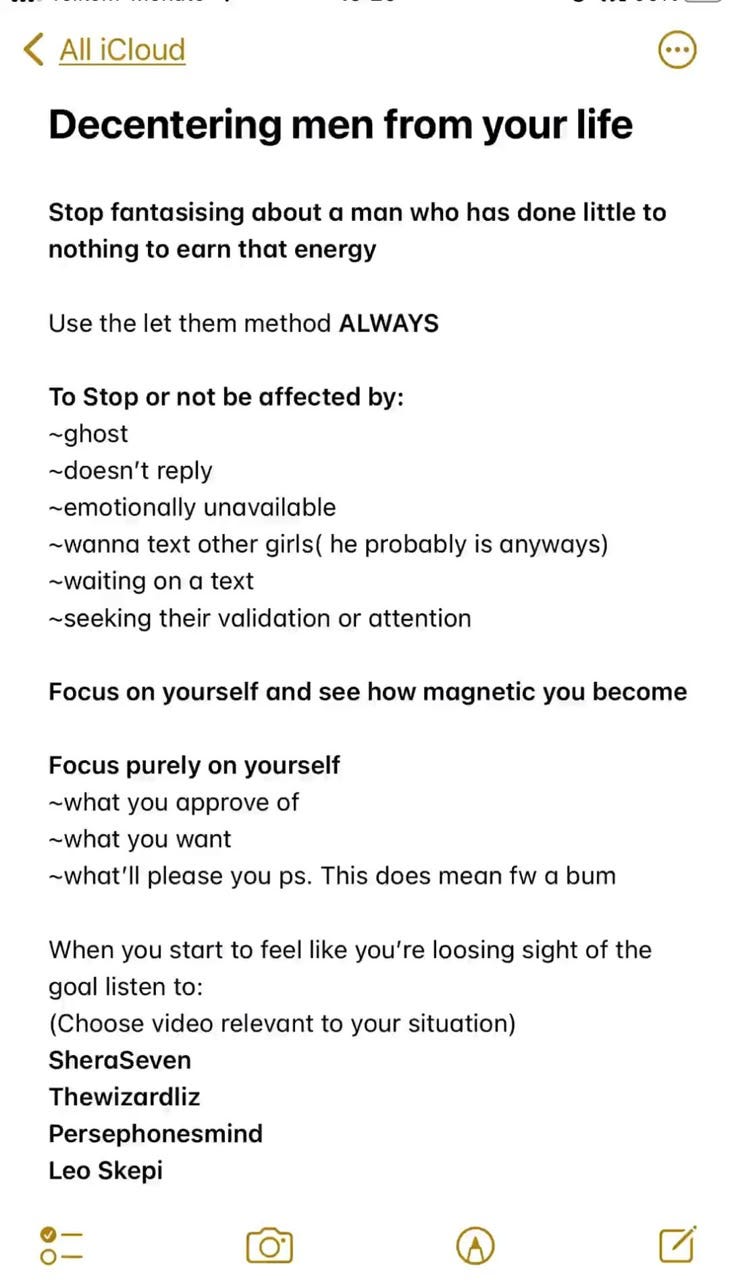
And while some of this advice can absolutely come from a well-meaning place — particularly in response to how many women are socialised to overextend themselves emotionally — I realised that, for me, it was becoming another performance.
I became so consumed with trying to focus on myself that I lost sight of who I actually was.
In trying to separate myself from my desire for romantic connection, I started disconnecting from parts of myself entirely. I treated my longing for intimacy as something embarrassing that needed to be controlled rather than understood. I thought empowerment meant distancing myself from my emotions instead of learning how to hold them safely.
Ironically, the more I tried to force myself into this version of hyper-detached womanhood, the more disconnected I became from my authentic self. I wasn’t becoming freer. I was becoming performative. I was so afraid of centering men that I began centering the avoidance of men instead.
My work within feminism, both personally and within the community I’ve built online, has always centred around the idea of BOTH / AND. I think many conversations become limiting when we force women into binaries that flatten the complexity of human experience.
Of course, not every issue within feminism can be approached through a BOTH / AND lens. Some things are inherently harmful. Violence against women, misogyny, coercion, abuse, and systemic inequality are not areas where nuance should dilute accountability. There are realities that demand clarity.
But when it comes to womanhood, identity, relationships, desire, and emotional experience, I think things are often more complicated than the internet allows them to be.
A woman can deeply value her independence AND still desire partnership.
She can critique patriarchal expectations AND still want love, marriage, or children.
She can build a life that exists fully outside of men AND still experience heartbreak, longing, attraction, or attachment.
I think feminism becomes most meaningful when it creates room for women to exist in their full complexity rather than prescribing another rigid way to perform womanhood correctly because if feminism only replaces one impossible standard with another, women still lose.
bell hooks has a line I kept thinking about while reading this: “To create loving men, we must love males… Loving maleness is different from praising and rewarding males for living up to sexist‑defined notions of male identity.”
What she’s naming is the difference between loving men and centring men. Feminism asks to decentre men in the sense of refusing to organize our lives, our politics, or our emotional labor around male entitlement. But that doesn’t mean withdrawing care. It means refusing to love men as patriarchal subjects and choosing instead to love them as human beings capable of transformation.
Loving men in this way isn’t about prioritizing them; it’s about refusing to abandon them to the emotional starvation that patriarchy trains into them. It’s a form of solidarity that doesn’t excuse harm, doesn’t recentre male needs, and doesn’t make women responsible for men’s growth. It simply insists that men, too, deserve liberation from the system that deforms them.
In that sense, loving men is not a betrayal of feminist decentring. It’s one of the ways we help men step out of the patriarchal roles that feminism is trying to dismantle.
as a woman who is choosing to not actively dating atm but still daydreams about love this was so great to read thank you thank you <3